
Hawk Mountain
Raptors, Ridges, Rangers, Runs ... and a Red Biplane

Updated 21 Jul 2026
My paternal grandfather told me he and his friends would climb up from Hamburg, Pennsylvania in 1929 to shoot goshawks for a $5 bounty ($100 in today’s money) each. Five years later, Rosalie Edge came up the same mountain and created the world’s first raptor sanctuary. That mountain — Hawk Mountain, at the top of Berks County — is one of my spiritual homelands, and I grew up with it looming in the background. I’m writing this from Bad Homburg, Germany, at the foot of the Taunus range, which looks exactly like the Blue Mountains, and from which ‘Hamburg’ was almost certainly corrupted. I hiked it, trained on it, skied it, and eventually flew over it in a 1929 biplane, all in the shadow of a landscape where my ancestors first put down roots nearly three centuries ago.
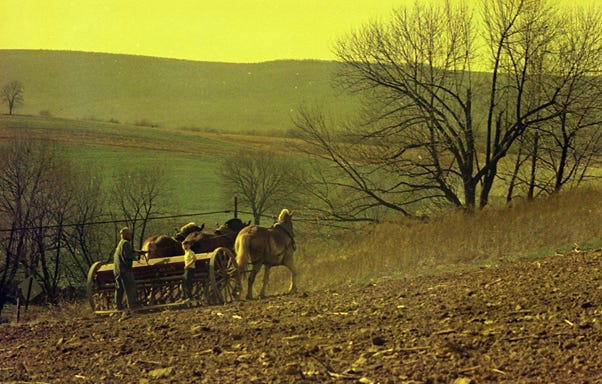
The author and Clarence Luckenbill, our neighboring Pennsylvania Dutch farmer, planting corn using a three-draft-horse seed drill on the lower-upper field at Wolfbrook Farm with the Blue Mountains (which look exactly like the Taunus) in the background, circa 1975. Photo credit: Robert George Lenhart Miller Jr., my father.
As I discuss in “My Father’s Side of the Family”, my namesake paternal direct-line 6th-great-grandfather Johann Joerg “Hunter George” Miller Sr. (1721-1801) was from Feldkirchen, Gönnersdorf in the western Rheinland-Pfalz; he’d arrived in Philadelphia on the ship “Aurora” in 1744 with his wife and two of their five eventual children, settled in Windsor Township, and is buried in the family plot at St. John’s Cemetery in Hamburg. Hunter George is listed by the DAR as performing “Patriotic Service” by paying the Supply Tax, as did his son (Johann Joerg) George Miller Sr. (1754-1815). Note that lots of the Revolutionary War grave flags one encounters are taxpayers to the cause, and not necessarily soldiers per se. Note also the blue Mountains in the background of the thumbnail photo of George’s grave:
We’re All Related

I recently made two posts on my family genealogy, one for my mother’s side of the family, and one on my father’s. On a trip back to the States last month, I was keenly interested in locating the grave of my-5th great-grandfather Johann Joerg "Hunter George" Miller Sr. (1721-1801)
By the way, “Hamburg”, Pennsylvania is actually a corruption of “Homburg”, Germany, where I’m writing this today. I personally updated (with supporting reference, see appendix) the Hamburg, Pennsylvania Wikipedia page to reflect it:
“In 1779, Martin Kaercher Jr. received 250 acres (1.0 km2) of land from his father and divided it into building lots, naming the area “Kaercher Stadt”. Hamburg was officially founded in 1787, generally thought to have been named after the “German Hamburg” due to the largely German population of the region. However, Martin Kaerscher Jr.’s father Johann Martin Kaerscher Sr. (1718–1787) emigrated in 1738 from Langenselbold in Hessia (then under Isenburg)[14] which is far from the northern seaport of Hamburg, so it is likely that “Hamburg” is a corruption of Bad Homburg due to the Blue Mountains’ very similar appearance to the Taunus mountain range.”
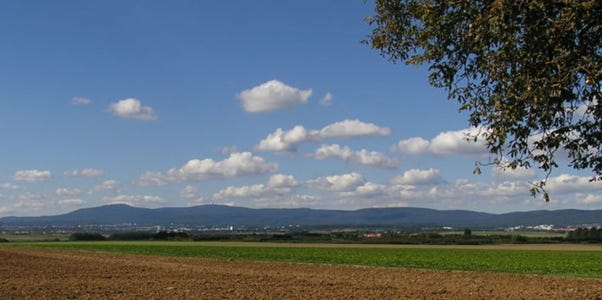
The Taunus, with Bad Homburg in the center. Source: Wikipedia
I deliberately used the term “looming”, as I wrote a piece describing the British-agitated Indian incursions over the Blue Mountains with which my ancestors had to contend, I included an account of a raid near the foot of Hawk Mountain at Eckville written by my 8th great uncle Jean Valentine Probst (1724-1775):
“The immigrant (Jean) Valentine Probst wrote to his father-in-law, Jacob Levan, about the terrible Indian raid of February 7, 1756, which occurred near the foot of Hawk Mountain at Eckville (where now stands the Bolich Church in Old Rosenthal): “I cannot omit writing about the dreadful circumstances of our Township, Albany. The Indians came yesterday morning, about 8:00 o’clock, to Frederick Reichelderfer’s house [Friedrich Jacob Reichelsfelder (1714-1759) was another 8th great uncle]. As he was feeding his horses, two Indians ran upon him, and followed him into the field 10 or 12 perches [a perch is equal to 5½ yards] behind; but he escaped and ran toward Jacob Gerhart’s house, with a design to fetch arms. When he came nearer Gerhart’s, he heard a lamentable cry `Lord Jesus, Lord Jesus’, which made him run back towards his own house, but before he got quite home, he saw his house and stables in flames; and heard all the cattle bellowing, and thereupon he ran away again. Two of his children were shot, one of them was found dead in his field, the other was found alive (and brought to Hagenbuch’s house) but died three hours after. All his grain and cattle were burnt up. At Jacob Gerhart’s they had killed one man, two women, and six children. Two children slipped under the bed; one of which was burned; the other escaped and ran a mile to get to people. We desire help, or we must leave our homes.””
The Probst family connection runs through the Lynn Township branch: Philipp Jacob Probst (1699-1747) is the common ancestor linking Jean Valentine’s Albany Township line to my own descent through the Brobsts.
The Indian raids on the Blue Mountain frontier were probably what made my ancestors more receptive to military service at the time, especially as the British eventually started employing Iroquois Indians as mercenaries to make further incursions over the Appalachians:
“In 1778, during the Revolutionary War, the Iroquois allied with the English and mounted one final attack against the settlers. They were repelled, however, and this essentially ended the rebellion of the Indians against the Pennsylvania settlers.
There’s even a restaurant between Shartlesville and Hamburg called the Indian Fort Inn where we’d sometimes go for dinner as a family, with a stone outbuilding where settlers would shelter in the event of a raid. I recall going out to it one evening as a child expecting to see Indians, but it was full of empty soda bottle cases. The adjoining house came up for sale years ago, and my wife and I actually took a look at it.
Further east there’s a break in the range where the Maiden Creek cuts through Lenhartsville, which was founded by my paternal 4th-great grandfather Heinrich “Henry” Lenhart (1773-1837) on land owned by his grandfather Johan Peter Lenhart (1708-1774); his father Johannes Jacob Lenhart (1736-1793) was from the Rheinland-Pfalz, and during the Revolutionary War was a Fifer, 2nd (Cpt. Jacob Ladich’s Greenwich Twp.) Co., 1st. (Lt. Col. Samuel Ely’s) Battalion, Berks County Militia, 1780.

The Hawk Mountain Range itself hasn’t changed much. What happens on it has.
Hawk Mountain Sanctuary
Hawk Mountain Sanctuary occupies 2,600 acres on the Kittatinny Ridge in Albany and Windsor townships, straddling the line between Berks and Schuylkill counties. Before it was protected, the North and South Lookouts were infamous killing fields: Gunners gathered each autumn to shoot raptors by the thousands as they funneled south along the ridge. The carnage drew Rosalie Barrow Edge (1877–1962) a Manhattan socialite, suffragette, and militant conservationist, who in 1934 leased the mountain and posted it against hunting, creating the world’s first sanctuary for birds of prey. The Sanctuary now counts more than 18 species of raptors and has logged over 90 years of continuous migration counts, the longest unbroken raptor census on earth.
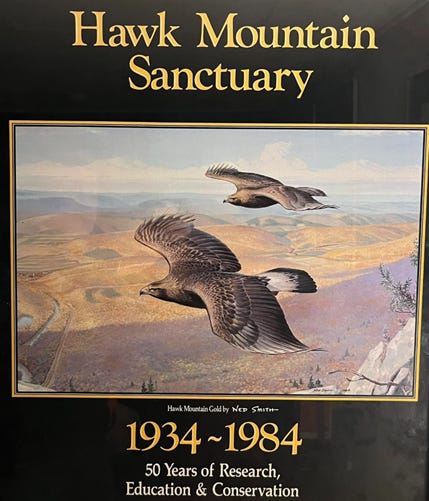
50-year commemorative poster in the author’s bedroom near Oley, Pennsylvania.
Rosalie Edge came from an Anglo-Dutch Protestant background. Her British father was a wealthy accountant and a cousin of Charles Dickens, and her mother traced her ancestry to the Dutch merchant Kiliaen van Rensselaer. Her husband was also British, and they lived in Asia for a few years before settling in New York. She picked a high-profile fight with the Audubon society, ran the Emergency Conservation Committee (ECC) from 1929 until she died, and campaigned to create Olympic and Kings Canyon National Parks, blocked logging of Yosemite National Park, and influenced founders of The Wilderness Society, The Nature Conservancy, and Environmental Defense Fund. One frequent Hawk Mountain visitor was Rachel Carson (1907-1964), who used data on bird populations collected by its caretakers as evidence in her influential 1962 book “Silent Spring”.
My paternal grandfather Robert George Lenhart “Grand Bob” Miller Sr. (1913-1999), about whom more can be found here , told me he and his friends were 16 in 1929, and would hike up from neighboring Hamburg to shoot predator birds for a $5 Pennsylvania Game Commission bounty each, about $100 today, making him in some small measure part of the carnage Rosalie Edge came to stop five years later. A goshawk raiding a chicken yard could take multiple birds in a single visit, and in 1929 rural Pennsylvania that was a genuine economic threat to farm families for whom every chicken counted. Game birds — pheasant, grouse, quail — were also both commercial and subsistence resources. The term “chicken hawk” wasn’t metaphorical. That said, wildlife must have seemed endless, even a century ago. Rosalie Edge’s radical insight, which put her at odds with the Audubon Society she considered too cozy with Hawk Mountain hunting interests, was that raptors were part of a balanced ecosystem rather than enemies of it. That was a genuinely controversial position in 1929, not an obvious one.
My parents and I have been members of Hawk Mountain Sanctuary for decades, and I’ve always felt we’ve been making amends for all those goshawks Grand Bob and his friends shot.
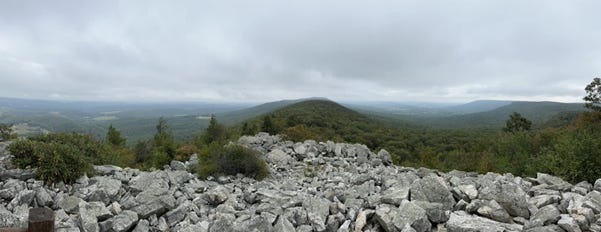
Panorama shot from the North Lookout looking east over the Kittatinny Ridge. Photo by the author, 2023.
Appalachian Trail, Pulpit Rock, and The Pinnacle
The Appalachian Trail crosses the Blue Mountains just west of Hawk Mountain and follows the ridge eastward to the Pinnacle, a quartzite outcrop at 1,635 feet that commands one of the broadest views in the mid-Atlantic: The Great Valley unrolls to the south, and on a clear day the towers of Reading are visible twenty miles off. The climb from the Hamburg reservoir trailhead gains roughly 800 feet over about three miles. The Pinnacle sits within State Game Lands 106, a 12,000-acre block that stretches along the ridge and makes the area one of the largest contiguous stretches of roadless terrain in southeastern Pennsylvania.
When I was in high school, We used to park at the Hamburg Reservoir and hike or mountain bike up to the Pinnacle . I still own some of Mamie’s ancestral forest land off the Appalachian Trail that I inherited from my Gran Chris. These plots were common as a firewood source amongst people who lived in town:

Pinnacle hikes are still a traditional activity when we’re all back in Berks County, even now that we’re in our 60s.
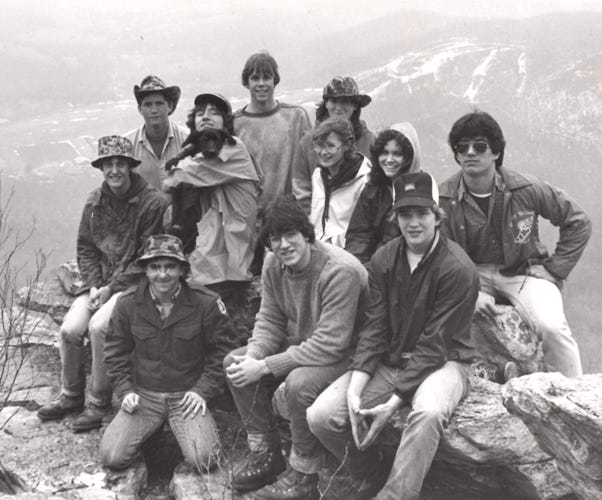
Pinnacle hike with high school friends, 1982. Hahn Mountain Ski area visible in the background.
CAP Ranger School
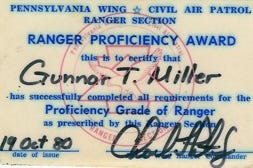
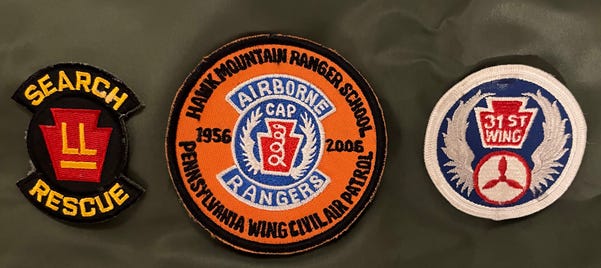
I was a member of the US Air Force Auxiliary Civil Air Patrol from 1979-1981. The Civil Air Patrol’s Hawk Mountain Ranger School traces to 1953, when USAF Pararescue instructors found their Pennsylvania Wing (PAWG) search-and-rescue trainees so impressive they called them Rangers. The school moved to Col. Phillip Neuweiler’s property on Hawk Mountain in 1956 and has operated there ever since, gaining national prominence in the 1960s and becoming the model for CAP ranger programs across the country. Courses run from basic land navigation and survival through advanced wilderness medicine and field communications, conducted on the ridge and in the game lands below. The CAP Ranger Section Land Search & Rescue Manual is still a great reference guide for outdoor woodsmanship and survival techniques. Parts 2, 3, 4, 5, 6, and 7.
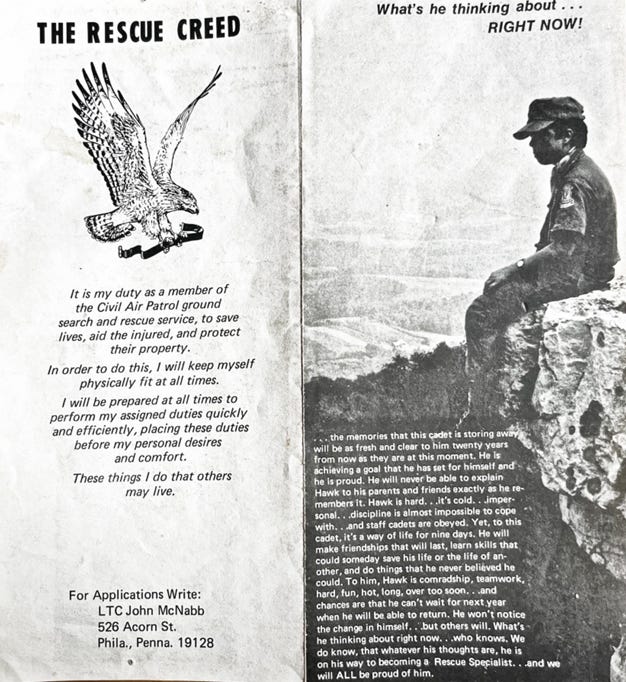
This brochure cover from the author’s collection shows a cadet sitting on Pulpit Rock .
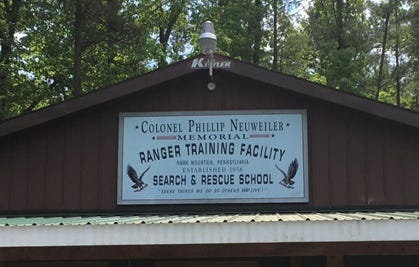
Photo by the author, May 2017.
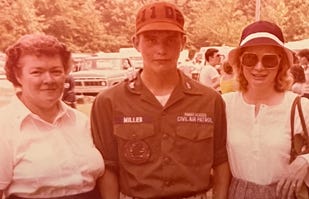
The author looking a bit haggard, CAP Summer Ranger School graduation, 1980. With Lt. Col. Elizabeth Magners of the Boyertown Squadron 1102 and my mother. After I attended Winter School, I earned my Ranger 1st Class, which was one of the hardest things I ever did.
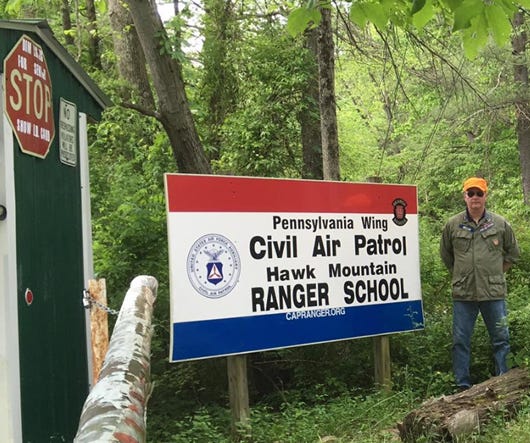
The author, May 2017.
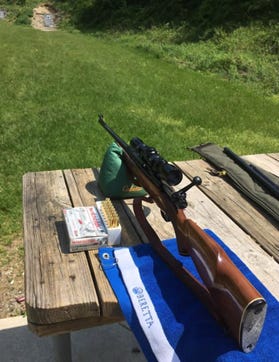
State Game Lands 106 in Eckville has a shooting range that the Ranger School used for AR-15s marksmanship training. I still use it today when I’m back home. The monstrous Cabela’s in nearby Hamburg has lots of ammunition.
Hahn Mountain Ski Area
I mentioned Hahn Mountain in the introduction to a piece I wrote on my ancestors, who were legion in the region:

Originally called Big Valley when it opened in the late 1960s, the area was later sold to the owner of the Hahn fire truck company in Hamburg and renamed. It offered three trails, a double chairlift, a T-bar, snowmaking, and night skiing, with a cap of 750 skiers on the slope at a time that kept lift lines almost nonexistent. The lodge had a game room in the basement and a bar on the upper level. It closed in the mid-1980s after a serious lift accident involving the owner. The slopes and lodge shell remain, steadily being reclaimed by scrub pine, visible from Route 143 north of Lenhartsville.
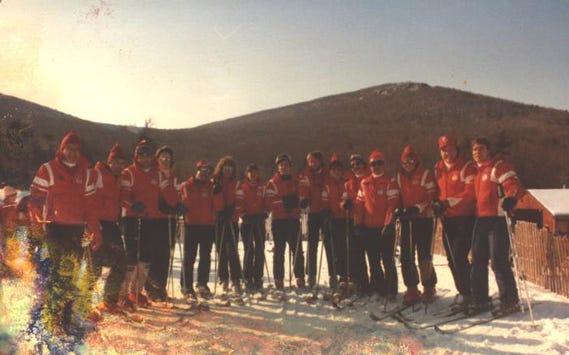
Hahn Mountain’s Ski School, circa 1982 or 1983. Photo provided by Barry Johnston, who served as a ski instructor at Hahn Mountain from 1979-1983.
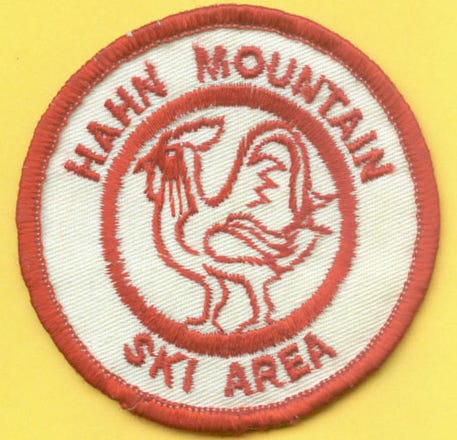
About 18 years ago, I wrote a comment on a “Lost Ski Areas” website:
I grew up in Berks County, and am getting quite nostalgic reading all this.
In my elementary school years, I grew up near the aforementioned Heidelberg Ski Area (aka Blue Marsh ... or Crystal something?). We lived ten minutes away and were members of the adjacent country club who founded it, and we would sometimes ski under the lights most weeknights after finishing homework and all day Saturdays and Sundays. It was a hardcore group of skiers, some of whom ended up moving out west as instructors. Even after we moved across the county, my father, sister and I would still make the c. 30 minute drive to get a few furtive hours in.
As a family, we had skied at Big Valley a few times, but once we were on the east side of the county and obtained driver’s licenses, we started going to Hahn sans parents on weeknights. It was a c. 40-minute drive in our ‘68 VW Bus, which leaked oil like mad (we’d drive to Hahn, put an oil pan under the engine, ski, and when we came out, we’d pour the drippings back into the oil filler) and had no heat. But, man, was it fun ... and our parents trusting us to handle studies and do this a few nights a week was a true self-esteem builder. A high school friend of mine actually bagged varsity basketball so he could ski there during the week. Another high school friend mowed lawns all summer just to be able to buy a season ticket in cash (I remember him peeling off the bills to buy it and thinking it was about as much money as I’d ever seen in one place at one time ... I think it was c. $125 [it was actually $170, or $732 in today’s money]). He would sometimes drive in a Chevy Citation: His POS car and complete lack of driving skills had us opting for the Bus most of the time. I remember a fill-up was c. $10 ... which is $22 [$43 at this writing] in today’s money, but given the oil crisis/double-digit inflation of the time it really felt like a lot of dough, but completely worth it if skiing was involved.
As we were all of PA Dutch stock, skiing was all about maximizing slope time with minimal lollygagging about in the lodge! As a season ticket holder, I remember literally putting on boots in the parking lot, skiing for three hours (I seem to remember 19:00-22:00 evening hours ... so homework between 16:00-18:00, dinner at home, and then the drive up), and getting straight back in the car to be home completely knackered by lights-out at 23:00-ish!
Ironically, a huge chunk of my family tree dates back to German settlers who founded Lenhartsville in the early 1700s, and I still own a bit of ancestral land near the slope in the family. I only recently became interested in genealogy, but had no idea at the time that every evening I was skiing a stone’s throw away from the gravestones of most of my family tree.
I live in Europe now and my children have learned to ski on a similar time capsule ski area (similarly to being an Allentown/Philadelphia suburb magnet, it’s the closest ski area to Holland and the German industrial north)
The smell of late season man-made snow whilst skiing under the lights takes me right back.
Aside from the usual Poconos locales, another area when I was in college was Little Gap (a.k.a Blue Mountain Ski Area ... Google it up). We also made high school ski trips to a place called Oregon Hill (now Sawmill) and my father learned to ski at a place called Pine Forge.
The prior comment on the combination of 1970s clothing (jeans, gaiters, cotton turtleneck, wool sweater, down vest, etc. etc.) and the often brutal weather really struck a chord ... my face today looks like a trainwreck, and I have never quite regained the feeling back in my toes.
A former racecar driver family friend once told me that “if you learn to drive on junk, you’ll be a star when you get behind the wheel of something real.” Same goes for skiing all that boilerplate.
P.S. Hahn was right around the corner from where I went through CAP Ranger training in 1981 http://www.pawingcap.com/hawk/ ... I distinctly remember a 20-mile hike/rappelling exercise where I looked down over Hahn Mountain from the Pinnacle and wished I was skiing instead of carrying a 50-pound field pack ;-)
P.P.S. The aforementioned WK&S railroad was (and from time to time I believe still is) a location for a traditional family fall picnic of which I have very fond memories.
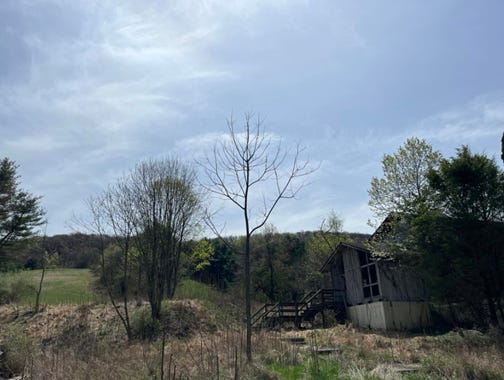
The remains of Hahn Mountain. Photo by the author, April 2025.
As mentioned in that P.P.S., right up the road in Kempton is the Wanamaker, Kempton and Southern (WK&S) Railroad, a.k.a. “the Hawk Mountain Line”, a steam excursion train that runs along Ontelaunee Creek in the shadow of the same ridge, and was the location for a traditional friends and family fall picnic of which I have very fond memories.
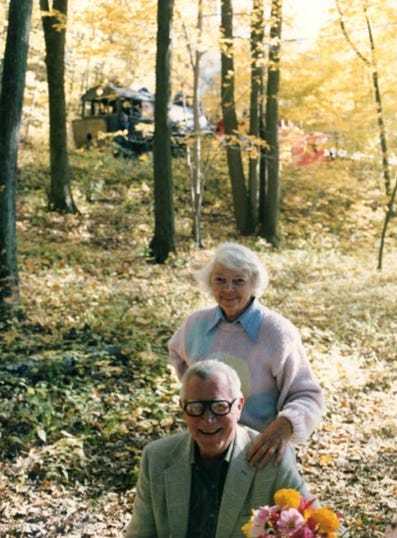
My paternal grandparents Gran Chris and Grand Bob, annual WK&S train picnic circa 1987.
Grimes Airport
Over towards Bethel is Grimes Airport and the Golden Age Air Museum. It’s a 50-acre turf strip sitting at 582 feet on the floor of the Great Valley two miles east of Bethel, in the shadow of the Blue Mountains. It hosts the Golden Age Air Museum, which focuses on pre-World War II aircraft and operates a fleet of flyable antiques including a 1929 Waco Model 10 biplane available for scenic rides over the valley. On a clear summer day, a passenger in the rear cockpit can look north and watch the ridge slide by at eye level, the same horizon that greeted the Pennsylvania Dutch settlers who came through the gaps three centuries ago.
There is something worth reflecting upon: That Waco 10 was built in 1929, the same year Grand Bob and his friends were climbing that same ridge with shotguns and a $5 bounty in mind. Rosalie Edge was still five years away from posting the mountain against hunting. From the front cockpit, looking north at the ridge sliding by at eye level, it is possible to hold all of that at once — the bounty hunters, the sanctuary, and ninety-five years of distance between then and now.
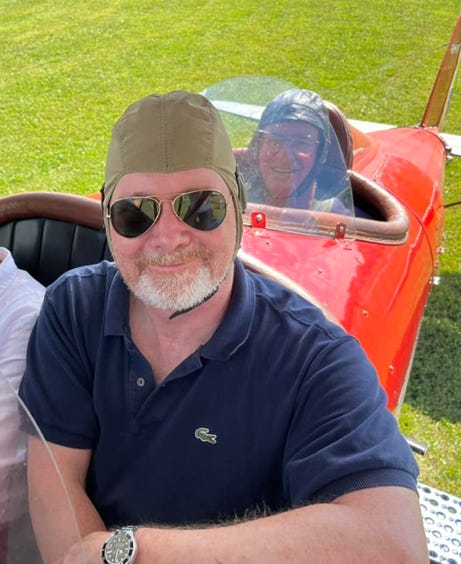
The author, in the Grimes Airport 1929 Waco 10, Jun 2024.
Takeoff:
Landing:
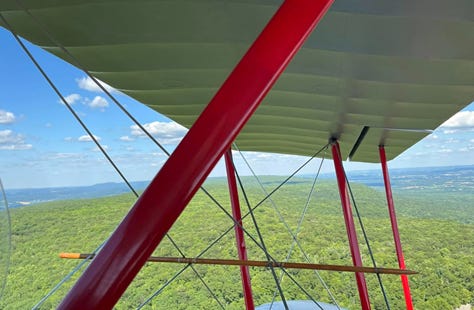
Over the ridge. Photo by the author, Jun 2024.
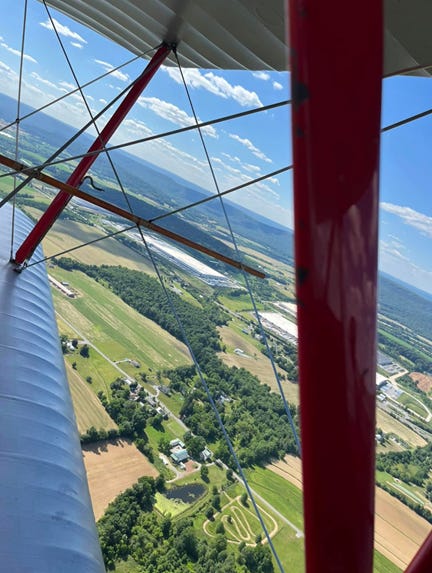
Photo also by the author, Jun 2024. The natural beauty (and road conditions) of the area is being encroached upon by warehouses and data centers. Asphalt’s the last crop.
Appendix
’Hamburg’, Pennsylvania
The spellings of Pennsylvania place names have varied over time but have been firm for well over half a century and could have been corrected where incorrect in this volume. On the base map, read Fredericksburg in Lebanon County rather than Fredricksburg; in Berks County, Heidelberg rather than Heidelburg; in Lehigh County, Hosensack rather than Hasensack. Incorrect place name spellings are also found in the “Informant Biographies” section: Centre (rather than Center) Township (114), Weisenberg (rather than Weisenburg) Township (115), Sweitzer (rather than Sweizer) Valley (116). The place Leck Kill, Northumberland County, “probably Washington Township” (119) is actually located in Upper Mahanoy Township. In the reprinted articles, a footnote might have been added to the “district” that Seifert (59) identified as Mühlbach: This most likely refers to the township of Millcreek. A footnote would also have been in order to Seifert’s suggestion (58) that “Low Germans first established the city of Hamburg [in Berks County].” Seifert was obviously misled by the fact that in Hamburg, Germany, Low German dialects are spoken. We now know that the name of Hamburg, PA is a misspelling of Homburg, of which there are several in the area where early immigrants originated.”
Hawk Mountain Sanctuary
A recent book just published this year titled “The Feather Wars” by James H. McCommons has an entire chapter on Rosalie Edge and Hawk Mountain. Here’s an excerpt which adds more color to my summary above:
“Raptors had found a champion in Rosalie Edge. In 1932, she attended a joint meeting of the Audubon Societies and the Linnaean Society to hear Richard Pough, a birder from Philadelphia, lecture about a massacre of hawks, owls, and other birds of prey he had witnessed on an isolated mountaintop in northeast Pennsylvania. Pough, who owned a chain of photography stores, had read a scientific paper by a biologist who had been examining the stomach contents of raptors. He obtained his specimens at a “hawk shoot” on Kittatinny Ridge near the town of Reading. Pough decided to see for himself and drove out to the shooting grounds at the end of a rutted dirt road overlooking the picturesque Pennsylvania Dutch farmland. He was astonished to see hunters packing pump and automatic shotguns, concealing themselves in the rocks, and gunning birds as they flew by at eye level. They tethered pigeons to poles for bait and tied wounded hawks to tree branches and poked them with sticks so they would cry out as decoys. In the brush and trees below the ridgeline, Pough found the bodies of hundreds of wounded and dead birds.
The slaughter, a tradition among local people, had been going on for decades during migrations, when the birds rode the thermals and wind currents along the spine of the mountains. Local newspapers celebrated the hunt as an opportunity to rid the land of vermin and protect small game and farm animals. The Pennsylvania Game Commission offered a five-dollar bounty on northern goshawks—good money during the Great Depression—but because most gunners couldn’t tell one hawk from another, they shot them all. There was so much shooting that a junk dealer went up the mountain each week during the hunt to harvest all the discarded brass shell casings for scrap. Years later Pough recalled, “Back then, hawks were a persecuted species. The only good hawk was a dead one.” Even ornithologists of the time used words like pernicious, cruel, malevolent, deadly, and noxious to describe birds of prey and their feeding habits.
Pough returned the following weekend with his camera and two companions, who hiked into the forest downslope and brought back dozens of dead and rotting birds. They lined the bodies up in an opening and took pictures. Pough displayed the graphic images in his talks and later published the pictures in Bird-Lore. He told the audience in New York that two square miles at the top of what was aptly named “Hawk Mountain” were available for purchase. The land was barren and used up—oak trees logged off and chestnut trees killed by blight—and was mostly mined for sandstone to be turned into glass or tombstones. He didn’t have the money, but perhaps help could come through donors or fundraising?
After the meeting, Gilbert Pearson and other Audubon members agreed that it should buy the mountaintop and establish a sanctuary there. Audubon created a twenty-eight-member owl-and-hawk committee to evaluate the society’s stance on birds of prey. They sent someone to look over the site, who, having seen neither hunters nor birds, reported back to the committee that there was no urgency. On the day of the site visit the wind wasn’t blowing, and thus the birds weren’t moving, so the hunters stayed home. A visit on another day would have been quite different.
Edge, disgusted at Audubon’s indecision and inertia, determined to do something herself. In June she went with Pough and a real estate agent to the mountain—a thirteen-hundred-foot promontory with a rugged sandstone spine—and took out a lease for five hundred dollars with an option to purchase for $3,500. The Depression-era price and the worn-out condition of the land made it a bargain, but ECC had limited funds, so she wrote to Van Name and asked to borrow the five hundred dollars until she could line up more donors.
She needed a warden and a caretaker. In fall 1934, she hired a friend of Pough’s, a young man he had met years earlier in Boston who had been working on ornithological projects. Maurice Broun, just twenty-nine, and his wife, Irma, came to Hawk Mountain for the fall migration. Knowing that Edge had limited funds, they agreed to work as wardens for just room, board, and expenses. They ended up staying for decades, making Hawk Mountain a world-renowned sanctuary and doing groundbreaking research into birds of prey. That first season, they had to face off the hunters and guard the road and trails leading up to the summit. It was dangerous work. The shooters were heavily armed and angry, and sometimes pointed their guns at the Brouns or discharged a shot in the air to show their displeasure. One local man said Maurice Broun was the most hated man in the vicinity. But there were other places to shoot birds along the Kittatinny Ridge, and the hunters eventually moved to new locations.
Several wealthy bird-watchers in Philadelphia and New York told Edge they would fund the purchase, but then the National Association of Audubon Societies—under new management and still smarting from its battles with Edge—convinced the donors to give the money to Audubon instead so it could take control of Hawk Mountain. Apparently, Pough was responsible for the change in loyalties. Rosalie Edge felt betrayed and refused to sell or accept any money from Audubon. Van Name, equally incensed, donated his five-hundred-dollar loan, and the two activists fundraised through the ECC, which allowed them to purchase the land in 1938 and incorporate as the Hawk Mountain Sanctuary Association. They even put language in the charter to keep the National Association of Audubon Societies at a distance. Audubon would never get ahold of Hawk Mountain.
In 1937, Pennsylvania passed a law protecting birds of prey except for accipiters—sharp-shinned hawks, northern goshawks, and Cooper’s hawks—which were still considered a threat to poultry and small game. Hawks were not fully protected until 1969. In the intervening years, the Brouns did important scientific work on Hawk Mountain, counting the birds and documenting their migrations. Their data on the decline of eagles and hawks helped Rachel Carson reach her conclusions on the deleterious effects of the pesticide DDT, which led to her landmark book Silent Spring.”
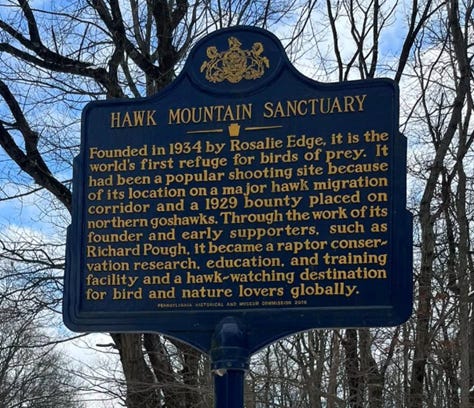
Historical marker. Photo by the author, Dec 2015.
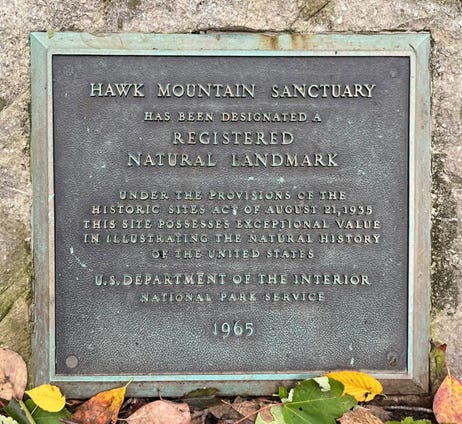
Registered Natural Landmark plaque, 1965. Photo by the author, Dec 2025
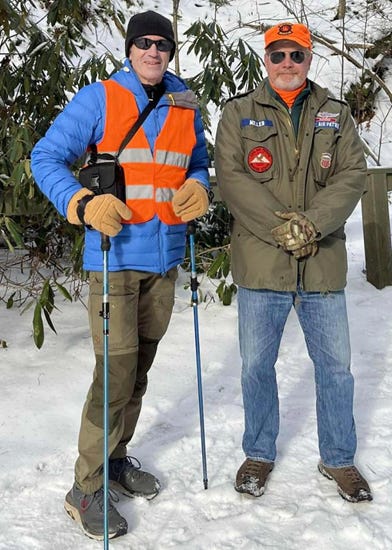
The author’s old CAP field jacket still fits almost half a century later. Blaze orange for safety during deer season. Friend’s photo, Dec 2025.
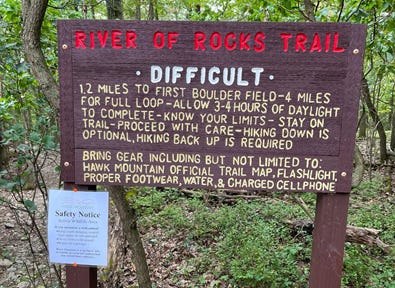
The River of Rocks Trail. Photo by the author 2023.
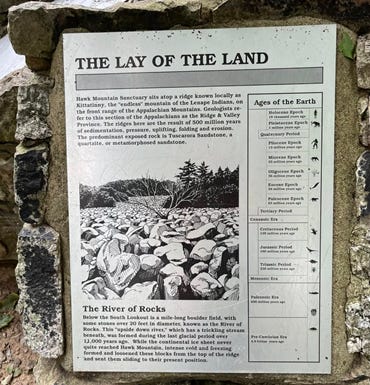
The River of Rocks. Photo by the author, 2023.
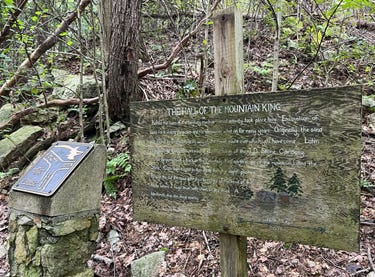
The Hall of the Mountain King. Photo by the author, 2023.
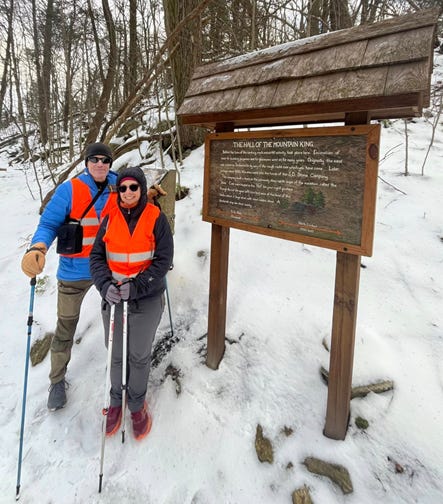
The Hall of the Mountain King. Photo by the author, 2025.
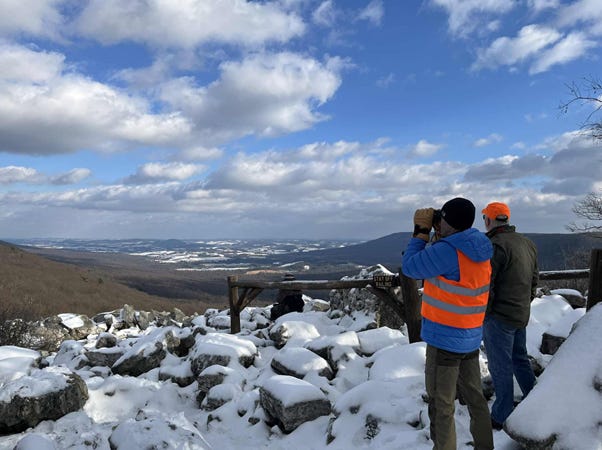
North Lookout looking east on a Hawk Mountain hike with friends, who took the photo, Dec 2025.
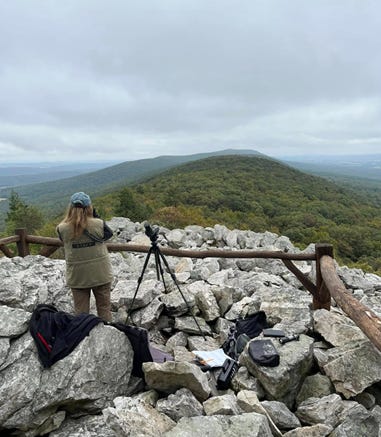
Raptor count, North Lookout looking east over the Kittatinny Ridge. Photo by the author, 2023.
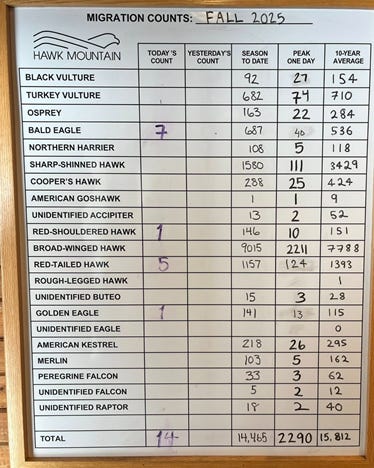
Raptor count, photo by the author, Dec 2025.
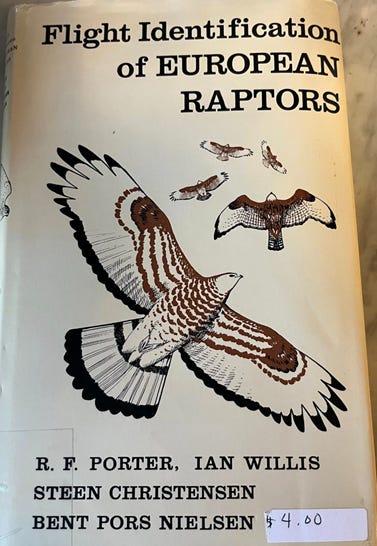
In December 2025 I bought a book from the bargain bin to take back to Germany ...
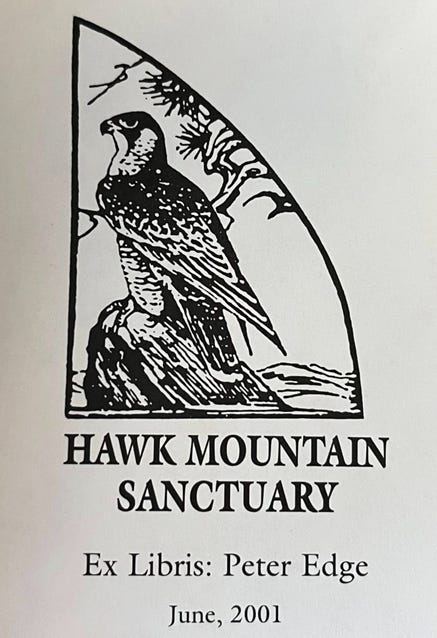
... and it turns out the book was originally owned by an Edge descendent.
The author’s favorite hat.
Port Clinton Hotel
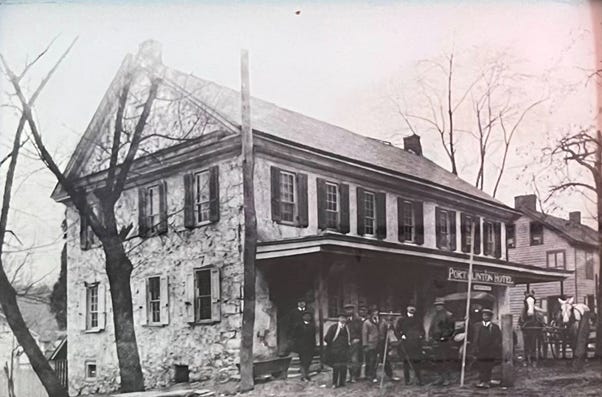
If you’re going to hike Hawk Mountain, breakfast or lunch at the Port Clinton Hotel is a must. Port Clinton is the hometown of my great-uncle Edmund Solomon Lenhart “Munny” Miller’s wife’s family, the Robinholds.
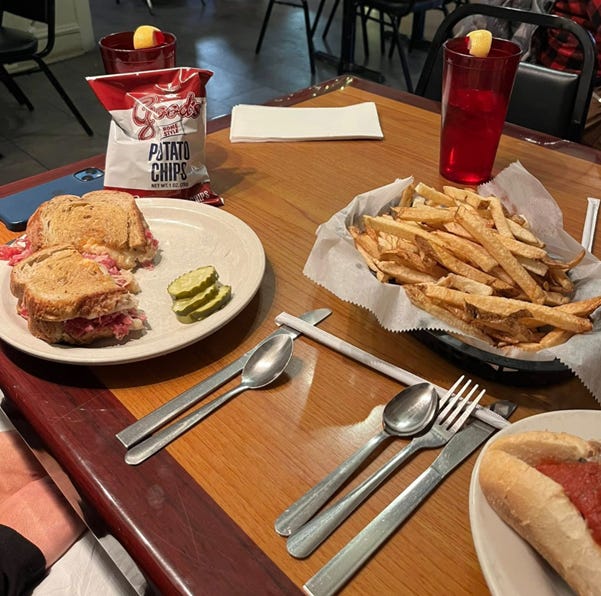
The Port Clinton Hotel, where the menu says it serves “The BIGGEST Portions in the AREA”. Local funeral home owner Domer Leibensperger (who went to high school with my father) still advertises on the front of the menu ...
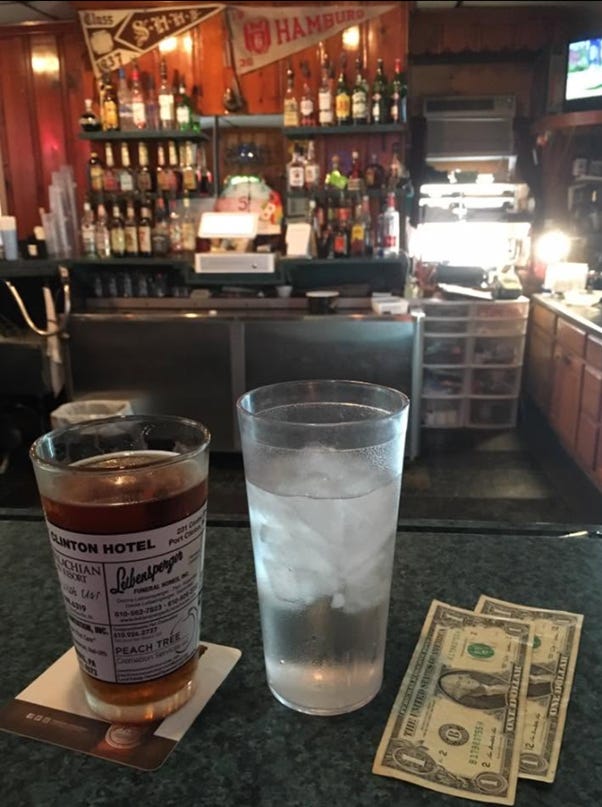
... and on the beer glasses as well. Photo by the author, May 2017
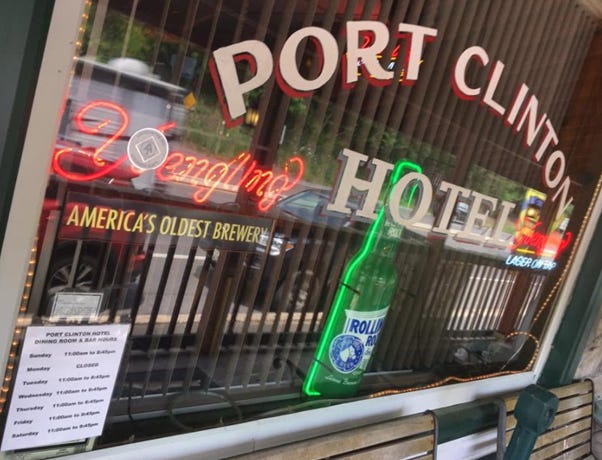
Photo by the author, May 2017. Note the Appalachian Trail sticker over the Yuengling sign.
Civil Air Patrol Ranger School
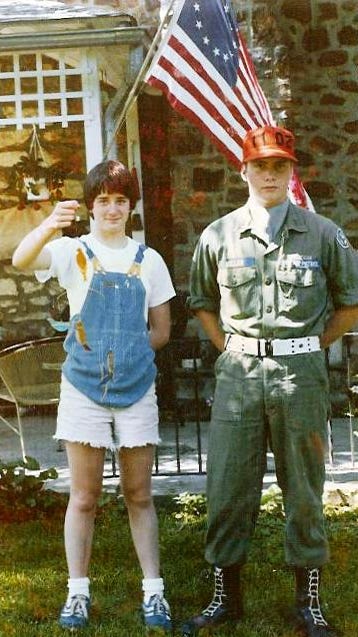
The author and sister at home near Oley, circa 1979-80.
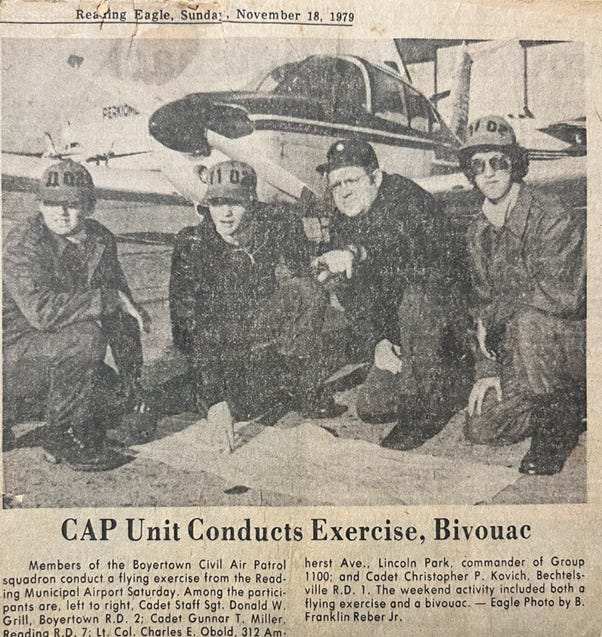
The CAP wasn’t just ground-pounding, but included flight training, which included grass strips such as Grimes Airport.
Hahn Mountain
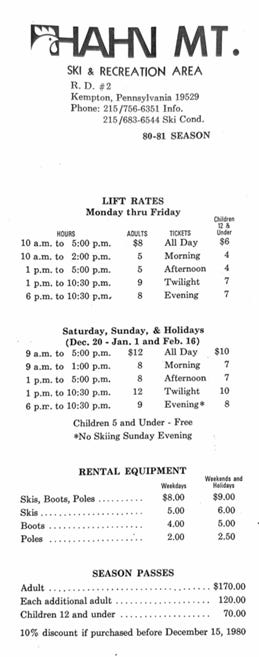
$170 for a season pass inflates to $732 in today’s money.
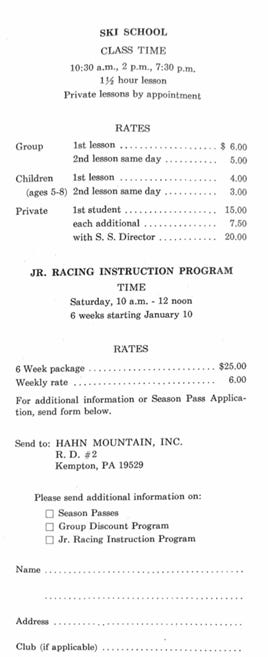
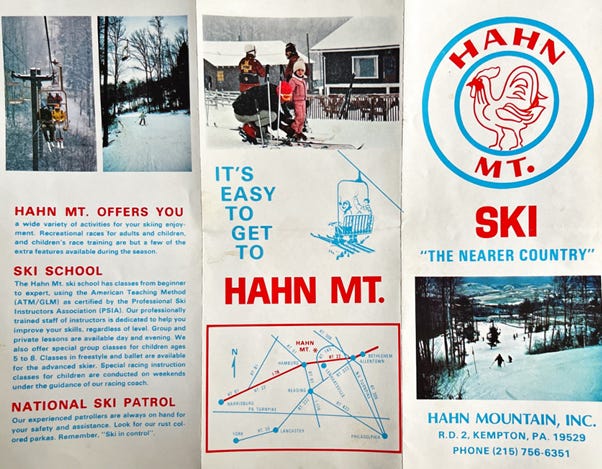
Brochure, collection of the author, circa 1980-83.
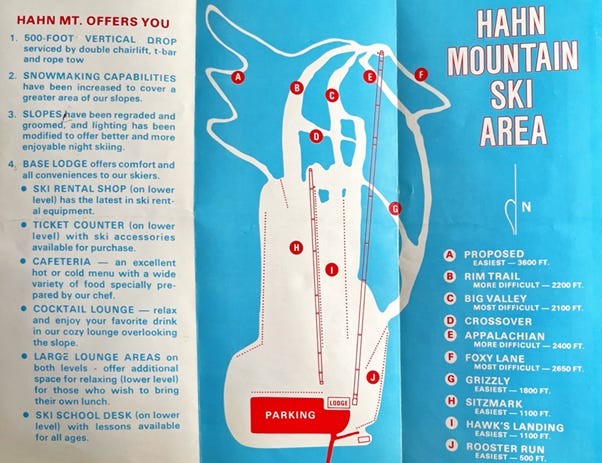
Trail map, collection of the author, circa 1980-83.