
Western Electric Engineering Fair 1982
How seven rural Pennsylvania high school kids accidentally invented home automation

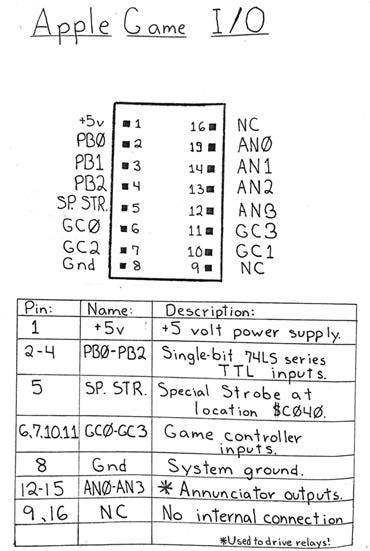
On one of my trips back home to Pennsylvania last year, I was pawing through some of my old high school papers, and (amongst some other ones https://gunnarmiller.substack.com/p/ye-olde-memes ) and found the submission a team of us made to the 1982 Western Electric Engineering Fair https://1drv.ms/b/c/5ed4c22a9f7768df/IQDfaHefKsLUIIBeEmQDAAAAARLt-wn2gZzCAQ19KLvO7o8?e=p2w3eI.
The Challenge
In the fall of 1981, a group of us Oley Valley High School students — Dan Haas, Scott Reider, Mark Miller, Larry Valariano, Bill Krapf, Doug Schneider, and myself (Scott and Bill would later become Chi Phi fraternity brothers at Lehigh) — were invited to Western Electric’s Student Engineering Fair and set ourselves an ambitious challenge: Design and build, from scratch, a computer-controlled switching interface capable of operating real electrical equipment. Rather than just describe the concept, we committed to building a working model.
People forget how big Western Electric https://en.wikipedia.org/wiki/Western_Electric and Bell Labs https://en.wikipedia.org/wiki/Bell_Labs were in Eastern Pennsylvania and Northern New Jersey. It was legendary, a status captured by this recent substack piece, as well as by Douglas “Generation X” Coupland https://www.wired.com/2014/09/coupland-bell-labs/ .

Berks County was amongst the first places in the country to have Touch-Tone https://en.wikipedia.org/wiki/DTMF_signaling . It seemed as though practically everyone had a parent or relative working there, and, sadly, a lot of them had much of their retirement savings eventually evaporate when Lucent stock went to zero https://en.wikipedia.org/wiki/Lucent_Technologies . But that was still almost a decade off., and “Ma Bell” was still firmly in charge of things.
The Computer
We chose the Apple II+ (stylized “][“ at the time) as our platform. Our small rural high school was actually pretty progressive when it came to putting computing power in the hands of students. We had a punch card-fed Litton Monroe 1860 (based on a Compucorp design) https://www.oldcalculatormuseum.com/d-compucorp.html . A number of us also had generous parents who bought us Texas Instruments TI-58C programmable calculators https://en.wikipedia.org/wiki/TI-59_/_TI-58 ; those were $300 at the time, which inflates to $1,040 in today’s money. But it was the Apple II+ that changed everything.
Those units had an instantaneous and much broader appeal. Kids used to come in before school started just to get some computer lab time. Sometimes it was laboriously manually pecking in programs from computer magazines and saving them on cassette tapes. Other times it was using the audio card to play complicated orchestral pieces. And sometimes it was just goofing around trying to see what these things could do (I recall the school could afford about four of them).
A friend of ours’ father had an Apple-focused computer store over in West Reading, and a few times a gaggle of us snuck in on a Sunday to use the machines, tape drives, and printers. We were finally caught red-handed, and I’m not certain whether he was angry or glad to see us getting into what I might call “productive mischief”.
The Design
Rather than using expensive peripheral cards, we discovered a clever backdoor: The Apple’s game controller I/O port had four software-controllable annunciator outputs that could be toggled with simple PEEK and POKE commands in Applesoft BASIC. We designed and built a relay driver circuit around 2N2219 NPN transistors and 1N914 switching diodes to buffer the tiny TTL signal from the annunciators and trigger six-volt relay switches.
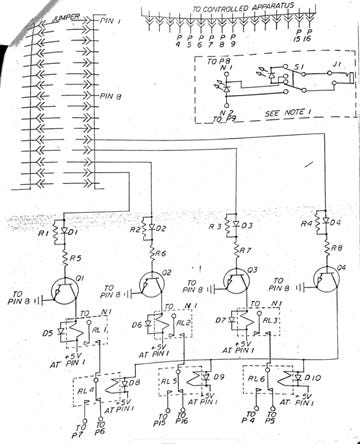
To demonstrate the interface’s capabilities, we built “Apatron,” a sheet-metal robot with three independently controlled motors (left drive, right drive, and arms), tethered to the Apple via a rainbow ribbon cable. The software included a master menu, a direct keyboard control mode, and a programmable indirect mode that let users record and replay movement sequences to disk.
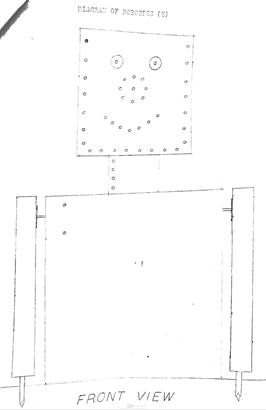
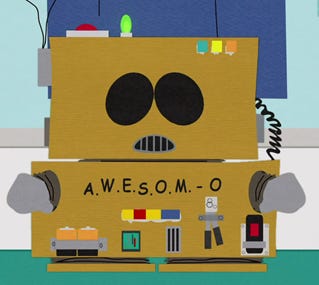
Side note: When I first saw South Park’s “A.W.E.S.O.M.-O” episode, I did a spit take because it took me right back to “Apatron”:
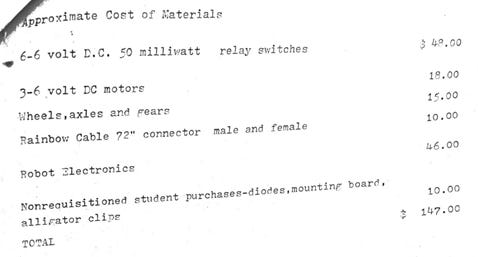
We won first place and a $600 grant for Oley Valley High School, which inflates to $2,079 in today’s money. The project cost was $147, which is $509 in today’s money. The biggest single line item was for the super-fine motor relays that could be triggered off the game port DIP plugs:
The Trust Exercise
It was already a pretty big deal that the school trusted us to start plugging homebrew electronics into $3,000 ($10,025 today) taxpayer-funded Apple computers. But then Western Electric asked us if we’d like to set it up at the Reading Museum for the entire summer as part of a technology exhibit. This would involve the school computer being used continuously for months, with the monitor showing the code lines as the commands were being executed. One funny part of this was that the robot ran on a tabletop, and essentially just went forward, waved its arms around, played some sounds through the speaker mouth holes, and moved back to the starting point. But over the course of the day slight differences in the motor-driven wheels would compound and it would fall off the table! We ended up building some rails, and it spent the whole summer delighting children.
I think those moments when adults trust adolescents are underrated moments in educational development. They could’ve just as easily said “too risky”. But they didn’t. I never forgot that.
The “Oh Wow” Moments 44 Years Later
The hindsight here is genuinely striking. What a group of rural high school students built in 1982 was, in essence, a home automation controller ... and we knew it. The “Alternative Applications” section of the report lists computer-controlled home heating and cooling, lighting, security cameras, intercom switching, and time-lapse photography. That’s basically a 1982 paper describing what Nest, Ring, Lutron, and SmartThings would commercialize 25–30 years later, built by teenagers with $147 ($509 in today’s money) in parts from Radio Shack and Hain’s Hobby.
The architecture we devised, a microcomputer sending software signals to a relay-switching interface that operates real-world devices, is identical in concept to what a Raspberry Pi running Home Assistant does today, or what an Arduino does when controlling motors. The vocabulary changed (GPIO pins instead of annunciator outputs; MQTT instead of PEEK/POKE), but the fundamental topology is the same.
The robot itself anticipated the modern maker/hobbyist robotics movement by about 20 years. The direct and indirect control modes, one for real-time operation, one for recording and playing back scripted sequences, map cleanly onto what we’d now call teleoperation and autonomous waypoint execution.
Perhaps most poignant: We wrote in the summary that we believed we were “among the first to build such a device for a home microcomputer,” and we probably weren’t wrong. The home computer was barely five years old. The idea that a $3,000 school computer could reach out and physically move objects in the world, that the boundary between software and the physical environment could be dissolved by a handful of transistors and a clever POKE command, was genuinely radical in 1982. Today we call that the Internet of Things, and it’s a trillion-dollar industry.
Not bad for a $147 rural high school project.
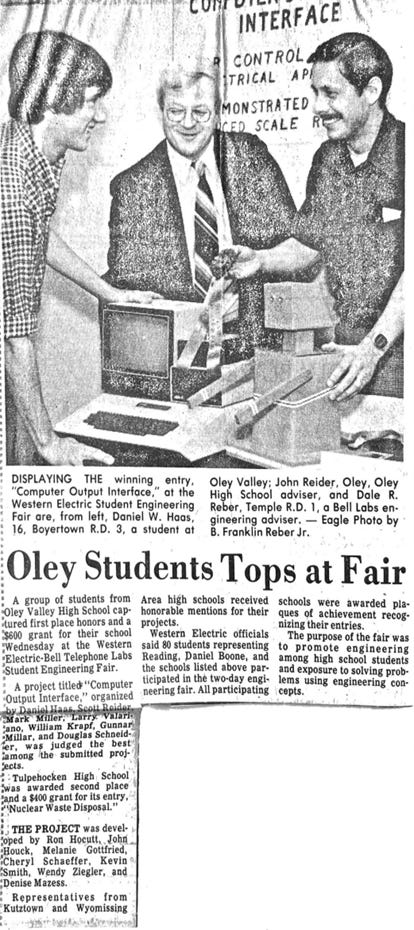
Note that this Reading Eagle/Times article misspelling my last name is yet another proof of Knoll’s Law of Media Accuracy https://en.wikipedia.org/wiki/Erwin_Knoll : “Everything you read in the newspapers is absolutely true except for the rare story of which you happen to have firsthand knowledge.”